
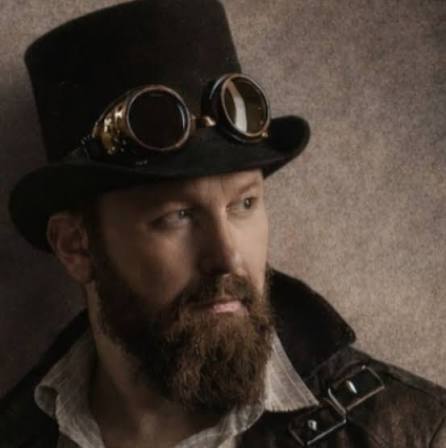
Martin Erich Vogiel
Německo 🇩🇪
Martin Erich Vogiel
Martin Erich Vogiel (born 1969 in Gliwice, Poland) is a German-Polish visual artist, photographer, poet, and theater actor who has been living and working in Essen for more than three decades. His life’s journey took him from mining in Upper Silesia to the world of contemporary European art, where he has established himself as a versatile artist who blends photography, painting, literature, and theater into a unique artistic language.
After studying at a mining school, he first worked underground at the Sośnica coal mine in his hometown of Gliwice. However, a desire for new perspectives and creative self-realization led him to Germany. There, he completed vocational training in gastronomy and worked as a chef for many years. Looking back, he describes gastronomy as a form of art—each dish as a unique composition of colors, aromas, and flavors. Nevertheless, his need to express his creativity on a deeper artistic level grew stronger.
From a young age, he captured his thoughts, observations, and emotions in poetic form. His poems are written in both Polish and German and have been published in various anthologies and literary journals, including by the publishers Fogue Verlag and Cornelia Goethe Literaturverlag, as well as in the German-Polish anthologies *Die Flüchtigkeit des Augenblicks*, *Schatten und Zeit*, and *Poetry Reading 6*.
At the same time, photography became an important part of his work. His photographic works explore light, time, memory, and human emotions. Through the exhibitions “Finsternis” and “Spiegel,” he presented his work to a wider public for the first time, thereby laying the foundation for his future artistic career.
Today, the focus of his work lies in painting. Using acrylic paints, textural pastes, and experimental techniques, Martin Erich Vogiel creates striking works full of dynamism, depth, and emotional intensity. His paintings straddle the line between figuration and abstraction and explore themes of identity, memory, belonging, and the transformations of modern society.
The painting “Fairground,” which was presented at an international exhibition in London, marked a significant milestone in his artistic development. The curatorial team of the renowned ITSLIQUID Group described this work as a dynamic and multi-layered visual world in which figures, gestures, and fragmented forms merge into a continuous flow of movement. The painting reflects the complexity of modern urban life and transforms everyday social experiences into a metaphor for the tension between individual perception and collective reality. “Fairground” is now regarded as the starting point of his unmistakable painting style and as a key work in his artistic development.
Martin Erich Vogiel’s works have been exhibited in many European cities. Among the venues for his exhibitions are Essen, Oberhausen, Gelsenkirchen, Gladbeck, Münster, and Cologne, as well as Prague, Antwerp, Venice, Rome, Barcelona, and London. His work is recognized both in traditional galleries and on international art platforms.
Despite his international reach, the artist has always remained true to his roots. His hometown of Gliwice holds a special place in his work. This is evidenced, among other things, by projects and exhibitions dedicated to the history, people, and cultural heritage of his hometown.
In addition to his work as a visual artist, Martin Erich Vogiel has been involved in theater for many years. He received his acting training under the guidance of Polish director Michał Nocon. Today, he is a member of various theater projects and collaborates with, among others, Tandem Theater. He has performed in Bielefeld, Solingen, Wuppertal, Darmstadt, Oberhausen, and in Poland, including in Kliczków and Tarnowskie Góry.
Martin Erich Vogiel is one of those contemporary artists who weave together various forms of expression into a cohesive artistic universe. Whether in painting, photography, literature, or on the theater stage, his work always centers on people, their emotions, memories, and visions. His works invite the viewer to see the world through new eyes and discover the hidden stories behind what is visible at first glance.
“Stories. Emotions. Visions. Captured in light, art, and words.”—this motto captures not only his work but also his personal artistic philosophy.


